Region
Trunk
The abdominal wall and the diaphragm — the muscles that stop your trunk moving when something is trying to move it.
6 structures · 6 muscles
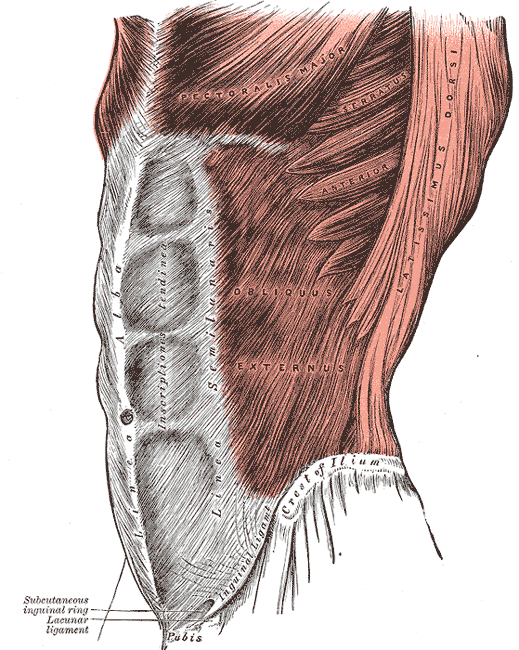
The abdominal wall from the side: external oblique over the ribs and iliac crest, running down to the linea alba.
The plate is captioned in the book, but that caption did not come through the scan legibly, so this description was written here from looking at the plate rather than guessed at.
Henry Vandyke Carter, plate 392 of Anatomy of the Human Body (Henry Gray, 1918). Public domain — file on Wikimedia Commons.

Bone structure
- Ribs
- Sternum
- Lumbar vertebrae
- Pelvis
Key functions
- Inspiration
- Trunk stabilisation
- Trunk rotation
- Trunk sidebending
- Trunk flexion
- Rib depression
- Lumbar stabilisation
- Pelvic tilt
- Abdominal compression
Muscle structure
- Diaphragm inspiration · trunk stabilisation
- External oblique trunk rotation · trunk sidebending · trunk flexion
- Internal oblique trunk rotation · trunk sidebending · trunk flexion
- Quadratus lumborum trunk sidebending · rib depression · lumbar stabilisation
- Rectus abdominis trunk flexion · pelvic tilt
- Transversus abdominis abdominal compression · trunk stabilisation
Tendons and attachments
- Diaphragm
- from Xiphoid process, the inner surfaces of the lower six ribs and their cartilages, and the upper lumbar vertebrae via two crura
- to The central tendon of the diaphragm
- External oblique
- from Outer surfaces of the fifth to twelfth ribs, interdigitating with serratus anterior and latissimus dorsi
- to Iliac crest, pubic tubercle and the linea alba, via a broad aponeurosis
- Internal oblique
- from Thoracolumbar fascia, iliac crest and the lateral half of the inguinal ligament
- to Lower three or four ribs, the linea alba, and the pubic crest via an aponeurosis
- Quadratus lumborum
- from Iliac crest and the iliolumbar ligament
- to Twelfth rib and the transverse processes of the upper four lumbar vertebrae
- Rectus abdominis
- from Pubic crest and pubic symphysis
- to Xiphoid process and the cartilages of the fifth to seventh ribs
- Transversus abdominis
- from Inner surfaces of the lower six costal cartilages, thoracolumbar fascia, iliac crest and inguinal ligament
- to Linea alba, pubic crest and pecten pubis, via an aponeurosis
Movements that load it
Where this came from
Every name, attachment and action on this page is read from The Atlas’s own records — each one checked against Terminologia Anatomica, and each one linked above so you can read the full entry. Nothing here is retyped or approximated, so this page cannot drift from the collection: it is the collection, arranged by region.
The figure is different in kind: it is sourced, not drawn here and not generated. A diagram is a claim, and an invented one is a claim nobody can check — so the plates are Henry Vandyke Carter’s, engraved for the 1918 edition and long out of copyright, credited above with a link to the file so you can verify the licence yourself. Being 1918, they carry the anatomical names of their day, which do not always match the modern ones used in the records.
Plate captions were read from the Internet Archive’s scan of the 1918 edition (anatomyofhumanbo00grayrich), and the licence of every plate was checked against its own file record on Commons rather than assumed from the age of the book. The build refuses to publish a page whose plate is not public domain.