Region
Arm
Between shoulder and elbow: the muscles that bend and straighten the arm, and the hinge they work across.
6 structures · 5 muscles · 1 joint
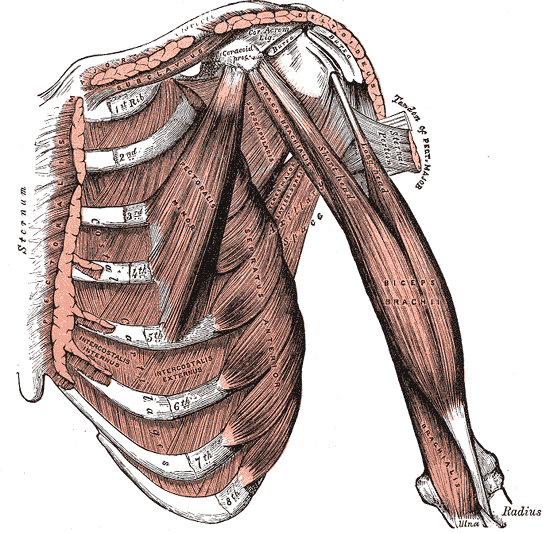
Deep muscles of the chest and front of the arm, with the boundaries of the axilla.
That is the plate’s own caption, as printed in the 1918 edition.
Henry Vandyke Carter, plate 411 of Anatomy of the Human Body (Henry Gray, 1918). Public domain — file on Wikimedia Commons.

Bone structure
- Humerus
- Ulna (upper end)
- Radius (upper end)
Key functions
- Elbow extension
- Elbow stabilisation
- Elbow flexion
- Forearm supination
- Shoulder flexion
- Shoulder adduction
- Forearm pronation
- Shoulder extension
Muscle structure
- Anconeus elbow extension · elbow stabilisation
- Biceps brachii elbow flexion · forearm supination · shoulder flexion
- Brachialis elbow flexion
- Coracobrachialis shoulder flexion · shoulder adduction
- Triceps brachii elbow extension · shoulder extension
Joints
- Elbow elbow flexion · elbow extension · forearm pronation · forearm supination
Tendons and attachments
- Anconeus
- from Posterior surface of the lateral epicondyle of the humerus
- to Lateral surface of the olecranon and the upper posterior ulna
- Biceps brachii
- from Long head from the supraglenoid tubercle of the scapula; short head from the coracoid process
- to Radial tuberosity, and the ulna via the bicipital aponeurosis
- Brachialis
- from Distal half of the anterior surface of the humerus
- to Tuberosity of the ulna and the coronoid process
- Coracobrachialis
- from Coracoid process of the scapula, by a tendon shared with the short head of biceps brachii
- to Medial surface of the middle of the humerus
- Triceps brachii
- from Long head from the infraglenoid tubercle of the scapula; lateral and medial heads from the posterior humerus
- to Olecranon of the ulna
Movements that load it
Where this came from
Every name, attachment and action on this page is read from The Atlas’s own records — each one checked against Terminologia Anatomica, and each one linked above so you can read the full entry. Nothing here is retyped or approximated, so this page cannot drift from the collection: it is the collection, arranged by region.
The figure is different in kind: it is sourced, not drawn here and not generated. A diagram is a claim, and an invented one is a claim nobody can check — so the plates are Henry Vandyke Carter’s, engraved for the 1918 edition and long out of copyright, credited above with a link to the file so you can verify the licence yourself. Being 1918, they carry the anatomical names of their day, which do not always match the modern ones used in the records.
Plate captions were read from the Internet Archive’s scan of the 1918 edition (anatomyofhumanbo00grayrich), and the licence of every plate was checked against its own file record on Commons rather than assumed from the age of the book. The build refuses to publish a page whose plate is not public domain.